
Is It Worth Fixing a 20-Year-Old AC Unit?

During the hottest days of summer, your air conditioner can stop working due to overheating, electrical problems, low refrigerant, restricted airflow, or worn-out components.
In some cases, the outdoor unit might make an unusual sound, and warm air may come from the vents. When you call the technician, you may receive a repair estimate for hundreds or even thousands of dollars.
Central air conditioners have an expected service life of 10 to 15 years. At 20 years, your system has exceeded its intended design lifespan by 33% to 100%. Internal components have suffered two decades of mechanical stress, heat exposure, and electrical wear.
This guide covers AC repair costs, older refrigerant costs, and the potential energy savings of upgrading to a modern system.
Using the $5,000 Rule to Compare Repair and Replacement
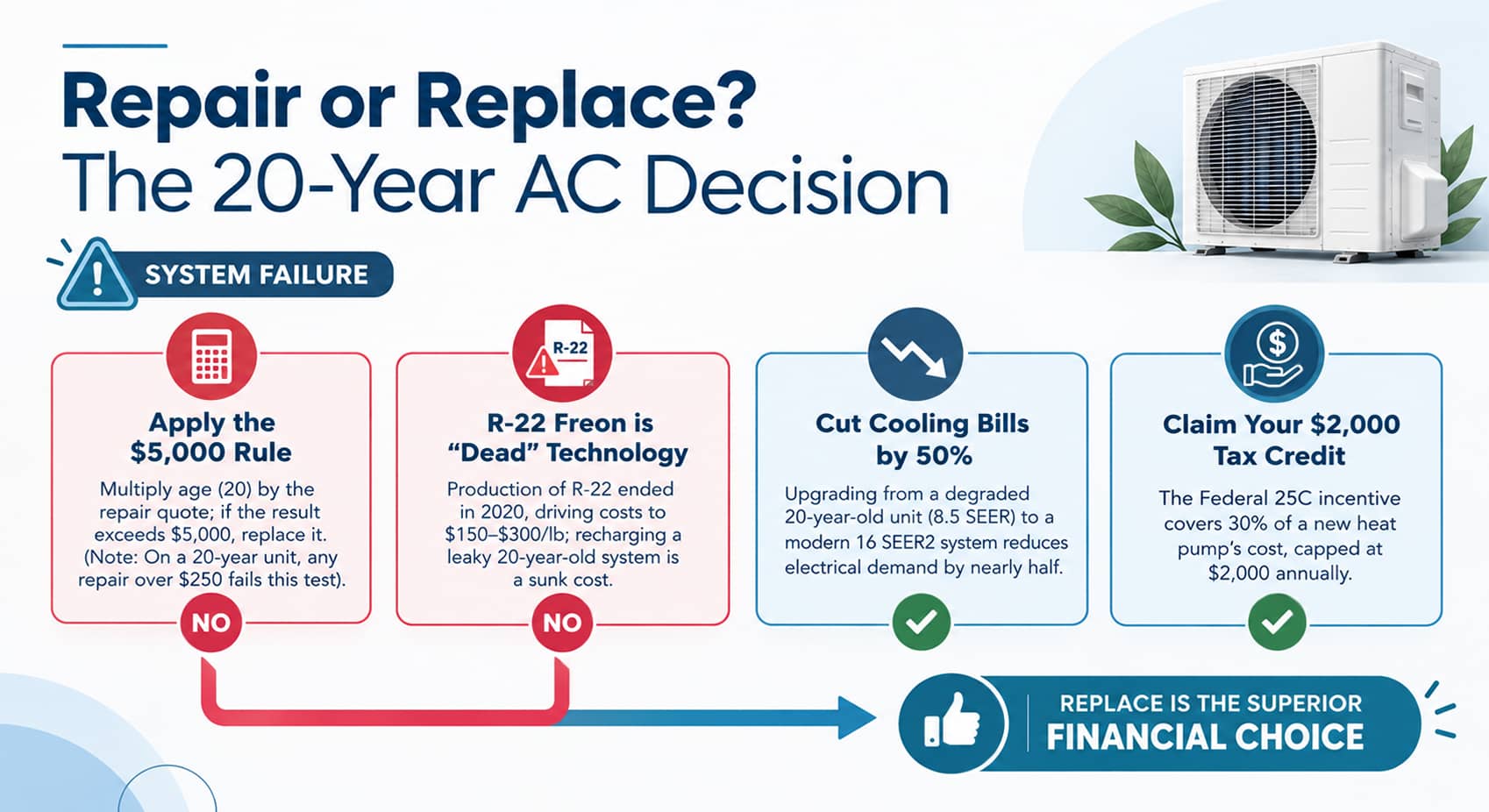
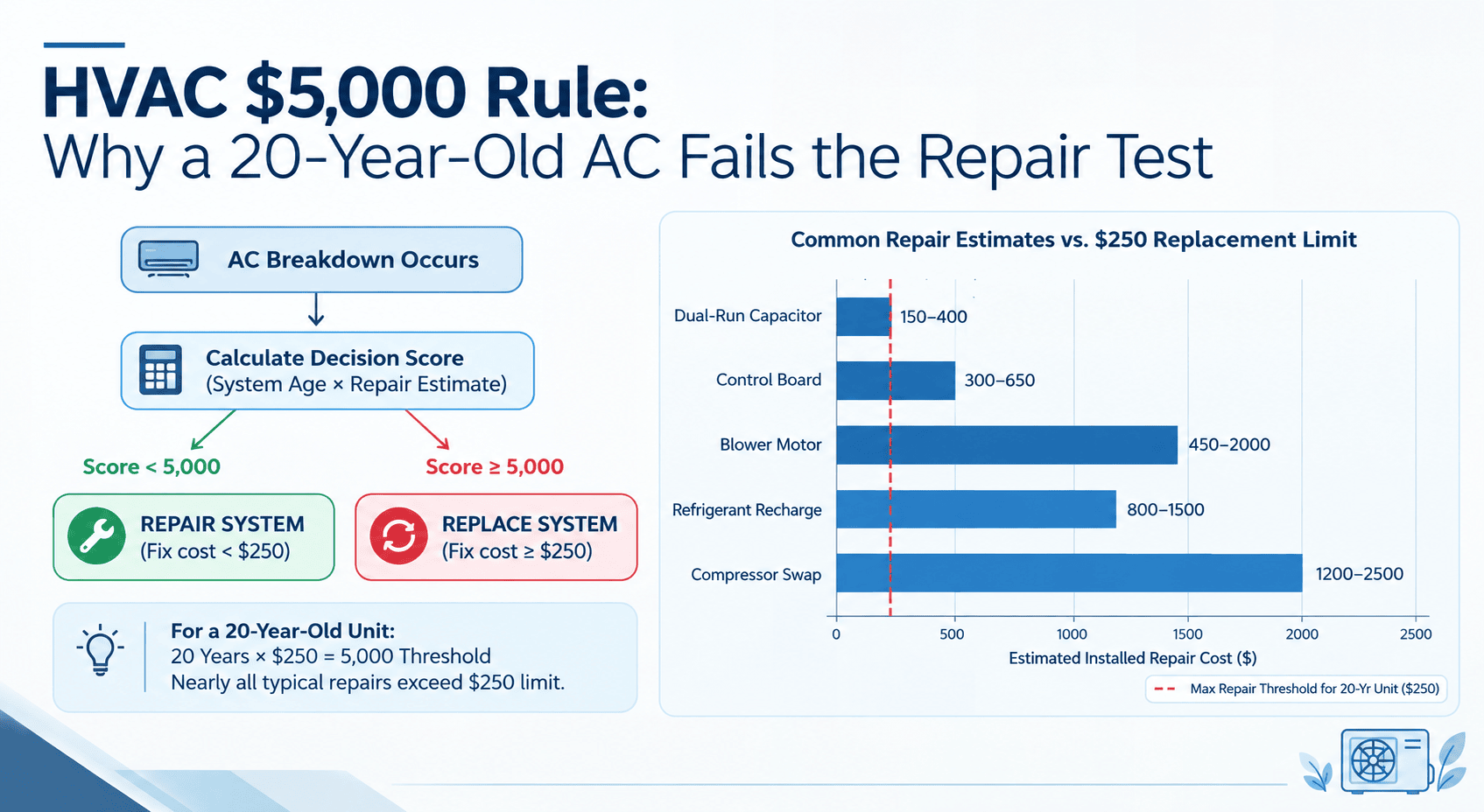
The $5,000 Rule is a simple guideline some HVAC professionals use to compare the cost of a repair with the age of an AC system. The formula multiplies the system’s age by the estimated repair cost.
System Age × Repair Cost = Decision Score
The $5,000 mark is used as the general threshold in this rule. A score below $5,000 suggests that repairing the system may be worth considering, while a score above $5,000 suggests that AC replacement may be worth considering.
For example, a 20-year-old AC with a $250 repair estimate would have a score of $5,000:
20 × $250 = $5,000
If the same repair cost $400, the score would be $8,000:
20 × $400 = $8,000
However, this rule is only a starting point. The type of AC repair, the system’s condition, energy efficiency, and the expected cost of future repairs should also be considered before deciding whether to repair or replace the unit.
The R-22 Refrigerant Problem
The age of your AC system can help determine which refrigerant it uses. Many older systems, especially those installed before 2010, use R-22 refrigerant.
Why R-22 Can Cost More to Service
The production and import of new R-22 refrigerant in the United States ended in 2020. Today, technicians rely on reclaimed or recycled R-22 when an older system needs additional refrigerant.
Because of this limited supply, servicing an older R-22 system can be more expensive than servicing a newer system that uses a current refrigerant. The AC repair may involve both fixing the leak and adding refrigerant if an older unit develops a refrigerant leak.
For a 20-year-old AC, the cost of refrigerant is one factor to consider when deciding whether to repair the system or replace it.
Energy Efficiency: Older AC vs. Newer Systems
Air conditioner efficiency is measured using a rating called SEER or the newer SEER2 rating. Higher ratings generally indicate that a system can provide cooling with less electricity.
A 20-year-old AC is likely to be much less efficient than many newer systems. Years of use can also affect the performance of components such as the coils, fan motor, and compressor.
A newer high-efficiency AC may use less electricity than an older system, which can help reduce monthly cooling costs. The actual savings depend on the system’s efficiency, size, condition, usage, and local electricity rates.
For this reason, potential energy savings are worth considering when comparing the cost of repairing an older AC with the cost of replacement.
When to Repair vs. When to Replace
The table below highlights situations where repairing or replacing a 20-year-old AC may be worth considering.
| When Repair May Be Reasonable | When You May Consider Replacement |
|---|---|
| The repair is relatively inexpensive. | The repair cost is a significant portion of the cost of a new system. |
| The issue is related to a smaller component, such as a capacitor, contactor, or thermostat. | The unit uses R-22 refrigerant and requires costly refrigerant service. |
| The system does not have a refrigerant leak. | The system has a refrigerant leak in the coils or lines. |
| You need a short-term repair while you compare replacement options. | The compressor has failed. |
| Your energy bills have increased without a change in usage. | |
| The system has needed multiple repairs in recent years. |
What to Consider Before Repairing a 20-Year-Old AC
Before deciding whether to repair a 20-year-old AC, go through this checklist:
Final Takeaway
The repair for a 20-year-old AC can be worth it when the problem is minor, and the repair cost is reasonable. However, the system’s age, repair history, efficiency, refrigerant type, and potential for future repairs should also be considered.
If the system needs a major repair, uses R-22, or has required several repairs recently, replacement may be worth considering. Comparing the repair estimate with the cost and potential energy savings of a newer system can help you make a more informed decision.
FAQs
What Is the $5,000 Rule for an Aging AC Unit?
The $5,000 Rule is a simple guideline that multiplies the AC’s age by the estimated repair cost. A result above $5,000 suggests that replacement may be worth considering. However, this rule is only a starting point and should not be the only factor in your decision.
Why Can an R-22 AC Be More Expensive to Repair?
New R-22 production and importation in the United States ended in 2020. Older systems that use R-22 may therefore cost more to service, especially when they have a refrigerant leak and need additional refrigerant.
Can a New AC Reduce Energy Costs?
A newer, more efficient AC may use less electricity than a 20-year-old system. Your actual savings will depend on factors such as the new system’s efficiency, size, usage, and local electricity rates.
Can a New AC Reduce Energy Costs?
Federal tax credits may be available for certain qualifying heating and cooling equipment. Eligibility, credit amounts, and requirements can change, so check the current IRS requirements before including a tax credit in your replacement budget.