
What Is the 20-Degree Rule? How It Affects Your Air Conditioner
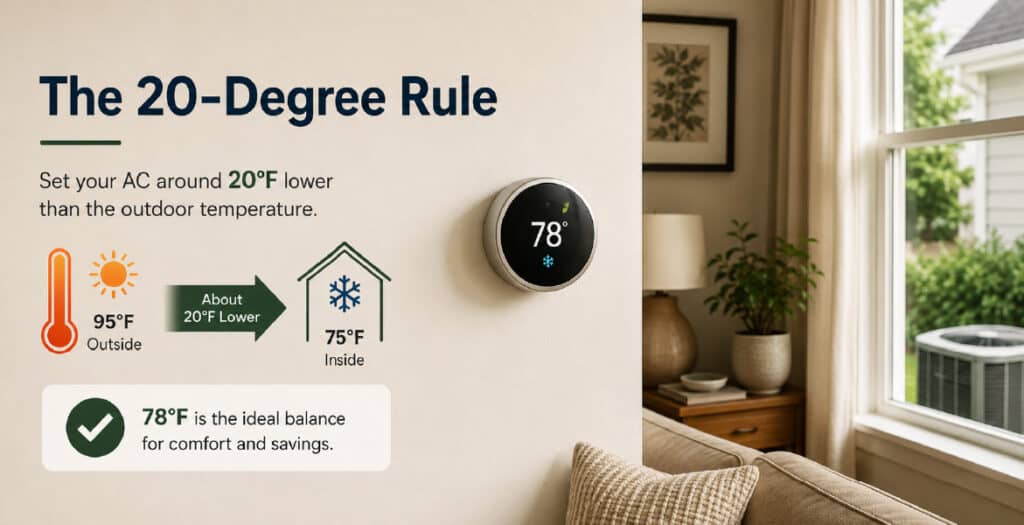
In summer, when homeowners return in the afternoon, they walk over to the thermostat and set it to 70°F or even lower to cool the space.
However, hours later, the house may still feel warm, and the thermostat refuses to drop below 78°F. You might think your air conditioner is broken, but it is often just following a physical guideline known as the 20-degree rule.
This rule is not a sign that your AC is failing. It is a guideline based on how air conditioning systems are built and how much cooling they can provide under normal conditions. Understanding this rule can help you set realistic expectations, reduce energy costs, and avoid unnecessary repairs.
The Two Different "20-Degree Rules"
The “20-degree rule” includes two separate concepts in air conditioning. One is about your AC’s cooling capacity, while the other helps check if your system is operating properly.
- The Outdoor-to-Indoor Split: It states that standard air conditioners can only cool your home about 20 degrees lower than the temperature outside. If it is 95°F outside, your AC can realistically keep your home at about 75°F. If the heat hits 100°F, you should expect your home to stay around 80°F.
- The Supply-to-Return Split (Delta T): This is a technical measurement that shows if your AC is working properly. It measures the temperature of the air as it enters your system (return air) and compares it to the temperature as it blows out of your vents (supply air). In a properly operating system, the air coming out should be 15 to 22 degrees colder than the air going in.
Outside Temperature | Realistic Indoor Target | Energy-Efficient Range |
85-90°F | 75-78°F | 76-80°F |
90-95°F | 76-78°F | 78-82°F |
95-100°F | 78-80°F | 80-84°F |
100°F+ | 78-82°F | 80-85°F |
(Data suggests 78°F as the ideal balance for comfort and cost.)
Why Your Air Conditioner Has a Limit
Your air conditioner does not actually make cold air. Instead, it works like a heat pump. It absorbs the heat from inside your house and moves it outside. This process uses refrigerant to absorb heat inside your home and release it outdoors.
Engineers do not size AC units to handle record-breaking heatwaves that only happen a few days a year. Instead, they use historical data for your specific area. They size the system to handle the temperature that occurs about 99% of the time.
If you live in a mild climate, your system is sized for that region. If you live in Phoenix, Arizona, your system is built much larger to handle 115°F days. A system that is too large for its climate will turn off too quickly. When this happens, it fails to remove moisture, and your home will feel cold but damp and sticky.
Humidity: The Invisible Workload
Temperature is not the only factor that affects how comfortable your home feels. Humidity also plays a major role. In humid areas like Florida and Maryland, high moisture levels can increase the workload on your AC system. Your AC system has two main functions:
- Sensible Cooling: This lowers the actual temperature you see on the thermometer.
- Latent Cooling: This removes water vapor (moisture) from the air.
When the air is very humid, your AC must spend up to 50% of its energy just wringing the water out of the air before it can start to lower the temperature. This is why a home at 78°F with low humidity often feels much better than a 74°F home that feels damp.
Why Setting Your AC Too Low Can Cause Problems
Your home will not cool faster if you set the thermostat to 65°F on a 100°F day. Instead, the AC will continue to run without reaching the set temperature, which can lead to several problems.
- The indoor coil can freeze when the system runs for too long. It builds up ice and can block airflow and damage the compressor.
- Your AC needs regular cycles to work properly. Long run times can put stress on the motor and other parts, which may shorten the system’s lifespan.
- Every degree below 78°F can increase your cooling costs by 3% to 8%.
How to Help Your AC During a Heatwave
When temperatures rise, your AC has to work much harder. These simple tips can help reduce the load on your system and keep your home cooler.
- Adjust Your Thermostat: Set the temperature at 78°F while at home. To save energy, if you are away for a long time, increase the temperature to 82°F or 85°F.
- Use Ceiling Fans: Use ceiling fans in a counterclockwise direction. They can make you feel up to 4°F cooler.
- Keep Sunlight Out: Close blinds and curtains on windows in direct sunlight. This will help to minimize the heat that enters your house.
- Limit Heat-Producing Appliances: Use the oven, dishwasher, and dryer during the morning or evening when possible. These appliances add heat to your home.
- Replace Air Filters: Change your air filter every 1 to 3 months. A clean filter improves airflow and helps your AC work more efficiently.
Is My AC Broken or Just Following the Rule?
If your home isn’t cooling as expected, the issue may be more than just the 20-degree rule. Here are a few signs that may require AC repair service: (Interlink to the service page)
- Lukewarm Air: The air blowing from your vents does not feel cold.
- Ice: You see ice on the refrigerant lines or the indoor unit.
- Odd Noises: You hear grinding, clicking, or loud humming from the outdoor unit.
- Rising Temperatures: The indoor temperature keeps going up even though the AC has been running for hours.
- Electrical Trips: Your AC frequently trips the circuit breaker.
If your home stays within about 20 degrees of the outside temperature, your system is likely performing as it should under a heavy load. However, if the gap is much larger, for example, it is 90°F outside, and your home is 85°F inside, you should call a professional for a check-up.
Summary
The 20-degree rule helps homeowners set realistic expectations during extreme heat. Your AC may not always reach the temperature you want, but understanding its limits can prevent unnecessary repairs, reduce energy waste, and help your system last longer.
FAQs
Does setting my AC to 65°F cool faster?
No. Setting your AC to 65°F will not cool your home faster. Your system cools at the same rate, but it will run longer, which uses more energy and puts extra strain.
How many degrees should my AC cool below the outside temperature?
Most AC systems can cool your home about 20°F lower than the outdoor temperature. For example, a 95°F day may result in an indoor temperature around 75°F.
Why is my AC running but not reaching the set temperature?
Your AC may be struggling because of extreme heat, high humidity, dirty filters, low refrigerant, or other system issues. If your AC cannot maintain a temperature within about 20°F of the outside temperature, it may need service.